THE NETWORKED MUSEUM: LESSONS FROM FINDING NEMO
This talk was presented at CIMAM 2025 in Turin, Italy.
0. THE BIG BLUE
Recently, on a transatlantic flight, I rewatched the Pixar classic, Finding Nemo.
I’d never actually finished it before — the premise gave me too much anxiety:
A clownfish named Marlin loses his son Nemo to a scuba diver’s net, and decides he’s going to cross the entire ocean to find him.
I remember thinking: How? How in the deep blue is this guy going to find his kid? The odds felt too daunting.
What surprised me on this rewatch was how the ocean is cleverly decomposed: not a monolithic “big blue,” but a shimmering web of currents, schools, support groups, and signals. Marlin encounters shark AA meetings, jellyfish enclaves, mimetic schools of fish, surfing sea turtles — each revealing itself as a node in a cultural ecosystem. He’s accompanied by Dory, a neurodivergent fish with short-term memory issues. She becomes an accidental catalyst — her forgetfulness and fluid trust push them into unexpected situations, and toward unlikely connections.
And Nemo — named for “no one,” echoing Odysseus — becomes the MacGuffin around which the entire network coheres, the absence that generates the story.
As Marlin’s tale travels — from pelagic whisper to aquarium glass — it becomes myth, carried across species, habitats, and media. The network is both infrastructure and imagination. The ocean becomes environment and archive
So, transposing this onto the museum, we might ask: what if the museum stopped positioning itself as the sovereign centre of cultural gravity, and instead became a node in a wider cultural ocean — a networked museum? How might its story ripple across publics, reaching distant and diverse participants? In an age of shifting economies, political antagonisms, and compressed attention, institutions must rethink not only what they transmit, but how: doing less, doing differently, transmitting not just objects but narrative, connectivity, and desire.
How do we plug into networks? Do we wait to be found — or do we scan, sense, and dive in? In Parallel Minds, Laura Tripaldi describes intelligence as emerging at the interface, the active region where materials meet. Our task as cultural actors is to design that active region deliberately — to cultivate the membrane through which signal-flow becomes meaning-flow.
We saw a brilliant example of this recently at the Met in New York. In ENCODED, 17 Indigenous artists overlaid their narratives onto the museum’s galleries via augmented reality. A surgical intervention: plugging directly into museum infrastructure — the galleries, the visitor flow, the smartphones — and rewiring the network of meaning to include marginalised voices. But beyond applauding their audacity, we might ask: what if we applied these lessons at scale? Because the networked museum must master not only the critical overlay — but also the ubiquitous footprint.
Remember Pokémon Go? That cultural eruption demonstrated how existing technologies — smartphones and GPS — could transform an entire city into an urban playing field, activating monuments and side streets as ports of attention. If ENCODED shows us the ethical depth of network-plugging, Pokémon Go gives us its spatial breadth. Together they reveal something crucial: the infrastructural groundwork for a networked museum already exists.
So let’s start here: With digital breadcrumbs in unexpected spaces. With AR portals at heritage sites. With collection narratives that surface globally, in situ, through the devices people already carry.
So — how does a story act as an agent of transformation? Not just riding the network, but reshaping it? McLuhan’s prophecy that “the medium is the message” has never been more literal. Twitter, TikTok — it’s not just that they’ve changed communication— they’ve re-patterned our collective cognition, attention, and desire.
Consider the institution struggling with static inventory. Last summer, the Louvre put out an open call to alleviate the chronic burnout around the Mona Lisa. The task was twofold: to manage the bottleneck and secondly to get visitors interested in the other exhibits. I sometimes consult for an experience design firm and during a brainstorm session around this, I suggested to “gamify” the situation. Instead of better signage, we would introduce narrative conductivity:
Why not turn the museum into a cinematic heist?
As visitors approached the Louvre, they would receive mysterious pings from an unknown entity recruiting them for a mission — blueprints, clues, team signals. The object of the heist would remain unknown, but the journey would activate the entire building. It was a proposal to transform the Louvre from a site of singular pilgrimage into a networked field of adventure. Common sense prevailed, and the idea was shot down immediately. And yet, especially in light of an actual robbery several weeks later, the moral of the story is clear: The museum is not just an archive of objects — it is an archive of narrative affordance.
The right story alters the physics of attention.
The right story recodes the space.
The right story converts static inventory into circulating desire.
Narrative alchemy shifts institutional virtuosity away from possession and toward connection — away from collection and toward flow.
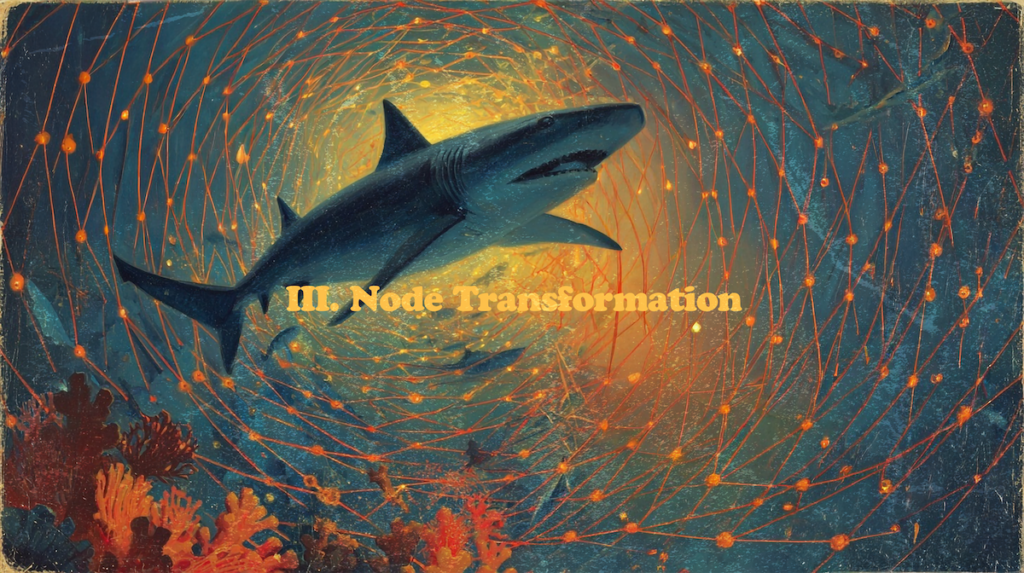
But for any of this to take root, a perceptual shift must occur. The institution must recognize itself as a node in a distributed intelligence — and act accordingly. I was delighted to discover one of the OMPA awardees Museo Barda del Desierto:
A museum without walls.
A museum that is permeable.
A shapeshifter that “holds on tightly and lets go lightly.”
A museum that listens as much as it broadcasts. A node understands that intelligence doesn’t live in the center — rather in the connective tissue between centers. As E.M. Forster says: Only connect.
Node transformation means embracing multiplicity, co-sensing with publics, collaborating with external networks, and making space for new narratives to transform the institution from inside its interfaces. It is the moment the museum stops asking, “How do we educate the public?” and begins asking, “How does the network express through us — in this moment?”
00. No One
The physics of a network determine its poetics — but through narrative we can alchemize the network itself: mutate affordances, reshape flows, and generate new nodes of meaning. Through network-plugging, narrative alchemy, and node transformation, institutions can become myth-machines — vessels of connection rather than vaults of things.
And so we return to Nemo, whose name means “no one.” A relinquishing of centrality. A surrender to the currents so the larger story can move. As Crush the sea turtle tells Marlin: “Just keep swimming, dude… and let the currents carry you.”